Hiconics, a Midea Group company, plans phased investment in Pakistan in 5-10 years.
Chinese renewable-energy solutions provider Hiconics, backed by China’s home appliance and technology giant Midea Group, is considering establishing manufacturing operations in Pakistan within the next five to ten years, as the South Asian nation undergoes a rapid transition toward decentralised energy systems.
Speaking exclusively to Business Recorder in Lahore, Hiconics President Ron Shen said the company sees Pakistan as a strategically important market, “particularly after the role Pakistan’s government has taken” during the ongoing tension between the US and Iran, acting as a mediator between the two countries.
The company also sees Pakistan as important from an “energy transition, political and geographic point of view”.
“We have 65 production centres around the world. It is also reasonable that we will be able to do something in Pakistan,” said Shen.
“I think in the long run, we are willing to do certain investments here,” Shen said.
The executive outlined a phased expansion strategy for Pakistan, beginning with product supply, ecosystem development, including service structure, local offices, and technical training, before moving toward localised assembly and manufacturing models, including ODM, SKD manufacturing, and eventually CKD operations.
“I think it should be around five to ten years,” he said when asked about a timeline for manufacturing in Pakistan.
However, any long-term manufacturing plans would depend on factors including political stability, regulatory certainty, tax policies, and overall business viability.
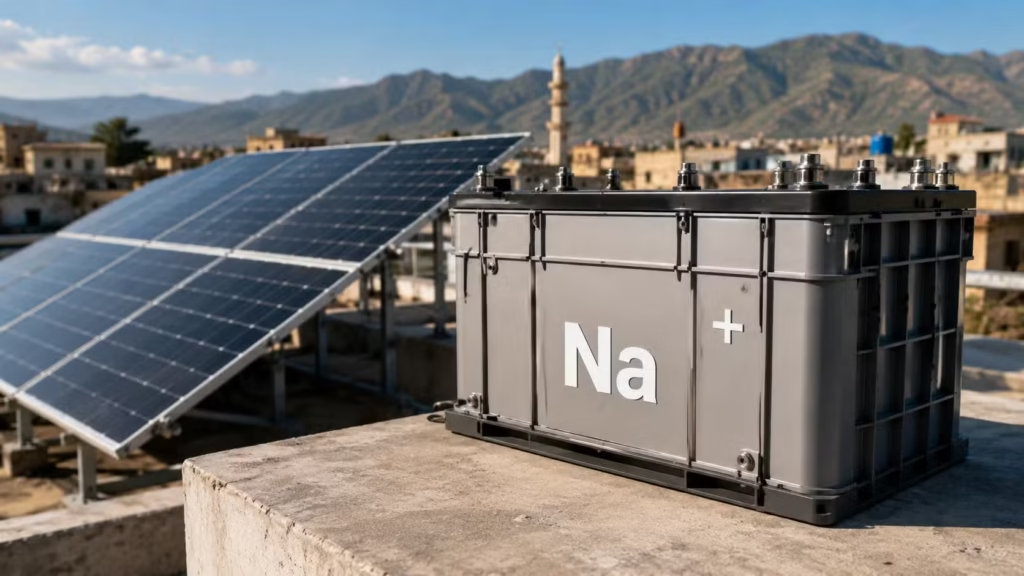
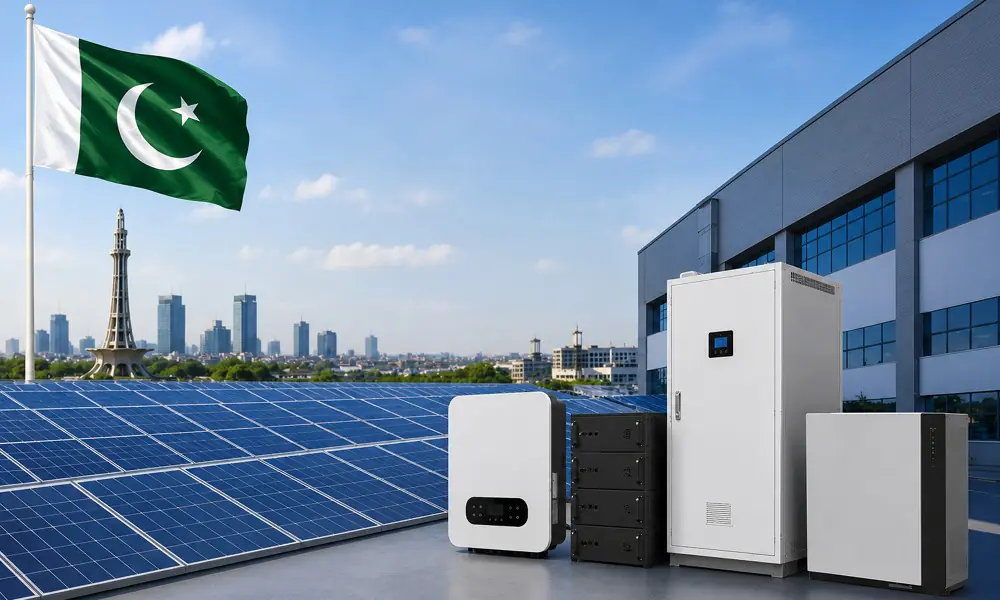
Hiconics operates under Midea Group, one of China’s largest technology and electronics companies with annual revenues exceeding $50 billion. The company specialises in renewable-energy solutions, including solar inverters, battery storage systems, variable frequency drives (VFDs), and smart energy management technologies for residential and commercial users.
The executive said Pakistan has emerged as a strong example of global energy transition, driven by rising electricity prices, power outages, and growing consumer demand for energy independence.
“In the past, Pakistan was more driven by utility-scale projects,” he said, but people are now moving toward decentralised systems, hybrid systems, and battery storage.
“The combination of batteries is also a global trend, which gives the end user real energy independence.”
According to the executive, geopolitical tensions and rising oil and gas prices linked to the ongoing conflict in the Middle East have further strengthened the case for renewable energy adoption.
“From a renewable business point of view, I think it is definitely a plus to accelerate [towards renewable].
“People are ordering more and more battery hybrid solutions because they fear interruptions in energy supply in the near future. So this definitely expedites the process of having the new solution,” Shen said.
The company executive also highlighted the growing role of intelligent energy systems and AI-powered energy management solutions in markets like Pakistan. “It’s becoming more critical and urgent.”
Hiconics plans to offer a full-fledged portfolio like the HVAC, heat pumps, air conditioning and also home electrical appliances through unified digital platforms.
The executive added that any future expansion in Pakistan would prioritise local employment, technical training, and knowledge transfer to help build a sustainable renewable-energy ecosystem in the country.