
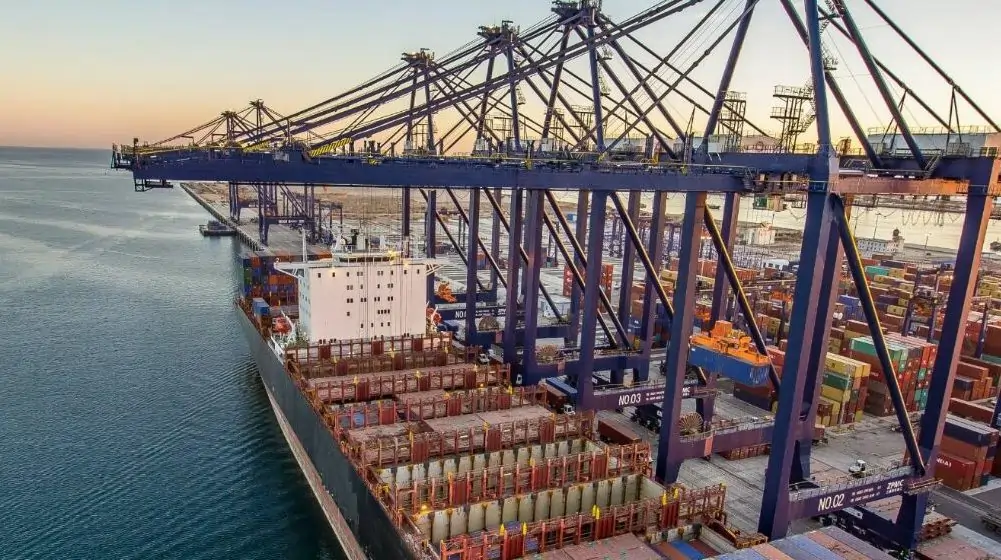
ISLAMABAD: Following the Middle East (ME) crisis, Pakistan’s Karachi Port has set a new record by handling 111,300 twenty-foot equivalent units (TEUs) in a single month. The port achieved this milestone recently by maintaining strong cargo operations.
Federal Minister for Maritime Affairs Muhammad Junaid Anwar Chaudhry announced this here on Wednesday, saying that to meet the challenges, the ministry, in close collaboration with other relevant authorities, has introduced major reforms to improve efficiency. He said that to promote and enhance business activities, the government has reduced port charges by 60 percent, which provided significant relief to the business community. As a result, traders gained better cost support and increased activity.
In addition, Port Qasim handled 3,485 TEUs with spare capacity, and Gwadar managed its first dedicated trans-shipment operation; four such vessels have arrived so far. This step strengthened its role in regional trade and logistics.
He said that a high-level committee formed in March positioned Karachi Port, Port Qasim, and Gwadar Port as a trans-shipment hub. “Swift and coordinated decisions in the national interest have reduced risks to trade, energy, and logistics,” Junaid Chaudhry said.
Furthermore, authorities announced the launch of four freight trains from Karachi Port to Pipri starting in September. This initiative will improve cargo movement and reduce transport delays
The minister described the Indian Ocean as a vital corridor linking Middle Eastern energy, Asian industry, African resources, and European markets, emphasizing that the Indian Ocean’s geopolitical tensions extend beyond trade and shipping, threatening global economies, regional stability, and national futures.
He said reforms with the Federal Board of Revenue replaced 100 percent scanning with risk management, slashing clearance times and enabling Less than Container Load (LCL) operations for small traders. The exporters at Karachi Port saw charges cut by 60 percent, and perishable exports were limited to 4 percent scanning.
Decisive action cleared years of container congestion as Port Qasim reached zero backlog, Karachi waived extra storage fees and auctioned surplus goods, and for the first time in its 137-year history, operations ran through Eid holidays with over 2,500 container movements, the minister added. “Pakistan has turned challenges into opportunities, maintaining trade continuity and building shipping resilience.
Timely decisions can position Pakistan as a rising regional economic power,” Chaudhry reaffirmed ports’ readiness for all challenges, crediting the federal government’s policies for uninterrupted oil supplies and business-friendly measures to boost trade.
Karachi Port Trust Chairman Rear Admiral Shahid Ahmed noted four trains will run from Karachi Port to Pipri starting in September, with modern edible oil terminals and ferry services already operational. “Karachi Port has capacity for the next 50 years,” he added. The government remains committed to establishing Pakistan as a maritime trade hub for regional connectivity and prosperity.