A student from Balochistan has earned international recognition for developing an innovative method to produce natural fiber from banana stems.
Mohammad Sarfraz, a researcher at the Balochistan University of Information Technology, Engineering and Management Sciences (BUITEMS), won the prestigious Discover Natural Fiber Initiative (DNFI) Award at the Heimtextil International Exhibition in Frankfurt, Germany.
The global competition attracted more than 100 research institutions and companies. Sarfraz impressed judges with his project that converts banana waste into high-quality, sustainable fiber, showcasing Pakistan’s growing potential in green innovation.
Sarfraz dedicated the award to his teachers and the youth of Balochistan. He revealed that he spent four years researching the extraction and processing of banana stem fiber. He expressed pride in competing successfully against projects from leading European institutions.
Dr. Mohammad Qasim, Head of Textile Engineering at BUITEMS and Sarfraz’s supervisor, praised the achievement and said it proves that Balochistan’s youth can compete globally when given opportunities.
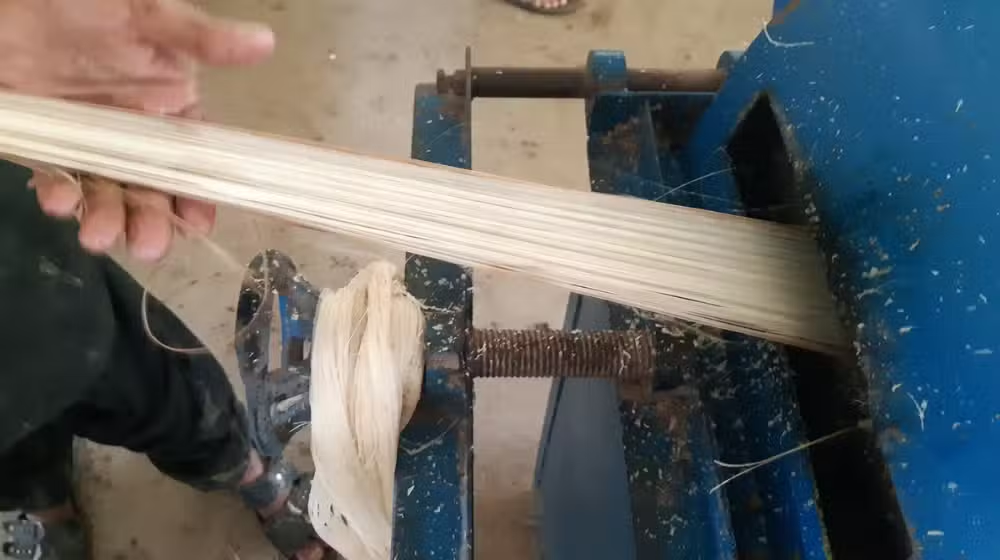
The project includes three stages: extracting fiber from banana waste, converting it into yarn and composites, and producing fabric and other products.
Industrial partner Mohammad Fawwad Supriya confirmed strong international interest in the innovation. European companies have shown willingness to collaborate, and a German firm has already signed a partnership agreement to manufacture and market products made from Pakistani banana fiber.
Fawwad said the initiative will create jobs and reduce poverty in Sindh and Balochistan. Fiber production has already started in Sukkur and Lasbela, and the next phase aims to involve 4,000 households.
Sarfraz has designed low-cost machines locally to support large-scale production. A unit of two machines costs around Rs700,000 to Rs800,000 and can produce up to 1,000 kilograms of fiber per acre of banana waste.
Experts estimate that Pakistan can produce nearly 500 million kilograms of natural fiber annually from banana waste, generating up to $1 billion in global market value.
The project also supports environmental conservation by reducing the burning and dumping of banana waste, which currently causes air and water pollution.
Sarfraz’s success highlights how innovation and local talent can transform agricultural waste into economic opportunity and sustainable development.