THE Lockheed Martin F-35 Lightning II, a single-engine, supersonic stealth strike, fighter, requires 400 kilograms of rare earth elements (REEs).
General Dynamic’s Virginia-class SSN-774 nuclear-powered attack submarine cannot be built without REEs. From Patriot missile systems (Raytheon) and Abrams tanks to Tomahawk cruise missiles, Javelin anti-tank missiles, and the AH-64 Apache helicopter (Hughes/McDonnell Douglas/Boeing), rare earth elements are essential to the production and performance of critical U.S. defense platforms.
The U.S. consumes over 25,000 tons of rare earth elements (REEs) each year and now classifies them as ‘war-critical’ materials. Pakistan’s Balochistan coastal sands, along with deposits in Chagai, Muslim Bagh, and Gilgit-Baltistan, are estimated to hold between 4 and 7 percent of global REE reserves, enough to potentially meet 15 to 20 percent of the U.S. Department of Defense’s (DoD) annual demand.
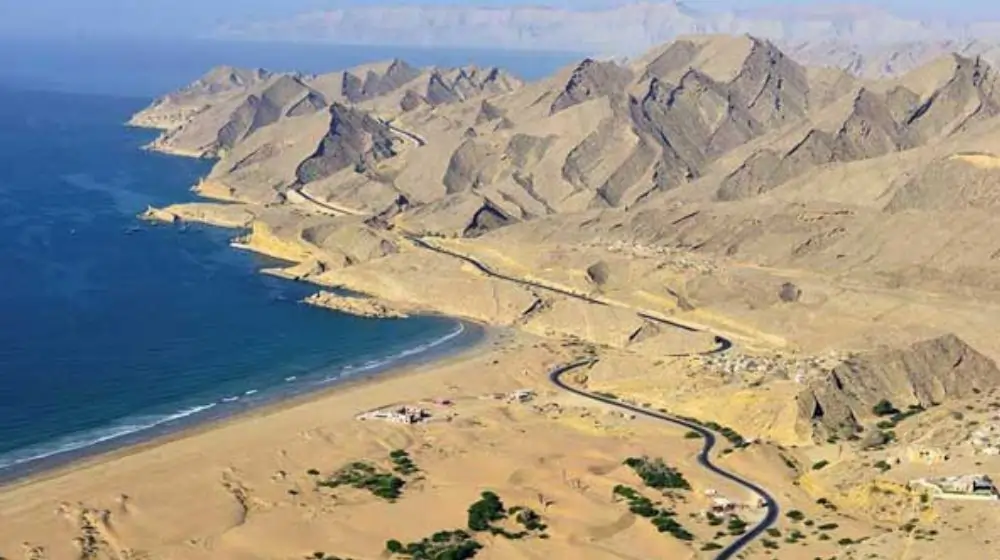
The sands along Balochistan’s 200-kilometre Makran coastline contain heavy minerals enriched with rare earth elements (REEs), derived from eroded upstream sources and mixed volcanic, sedimentary systems. Nearby ophiolitic belts around Khuzdar and Muslim Bagh also host REE-bearing and associated heavy mineral deposits. The confirmed presence of monazite, a phosphate mineral rich in REEs, indicates that Balochistan’s coastal sands could serve as a viable feedstock for REE extraction.
Pakistan possesses three key geological characteristics, tectonic, geochemical, and mineralogical, that make it favorable for rare earth element (REE) potential. The country sits atop a metallogenic belt formed at the convergence of the Indian and Eurasian plates, a region known to be rich in REEs. Strategically, Pakistan’s location along the Arabian Sea places it at a critical juncture in global supply chains, offering direct access to the U.S., EU, and Indo-Pacific allies.
Based on geochemical surveys and preliminary assessments, Pakistan’s key REE-bearing sites, including Leo Shilman, Chagai, Sillai Patti (Malakand), Saindak, Warsak, the Peshawar Basin, and Skardu, are estimated to contain around 500,000 tons of recoverable total rare earth oxides (TREO). At a conservative average price of $60,000 per ton, this represents an in-ground potential of roughly $30 billion before extraction and processing costs.
DoD Title III is a powerful U.S. federal law that allows the Department of Defense to fund, incentivize, and expand industrial capabilities critical for national security. DoD’s Defense Logistics Agency (DLA) is the sovereign buyer that guarantees price floor and offtake. The U.S. International Development Finance Corporation (DFC) provides political risk insurance. The Office of Strategic Capital (OSC) provides funding.
This is the Concept of Operations (CONOPS): Pakistan loads REE ore concentrate and ships via secure logistics to the Malaysian separation plant. Malaysian plant processes ore, produces separated REE oxides and metals; ships classified feedstock to U.S. magnet plants. U.S. magnet plants make permanent war-magnets according to DoD spec.
Pakistan has the geography and the geology, all that is needed is a gateway. The United States, in turn, has the technology, the market, and the capital. Pakistan needs a refining corridor, a financing mechanism, and access to global value chains. Pakistan has the mines, America has the system. One provides the feedstock; the other transforms it into war-magnets.