Fiber coverage to rise from 16% to 60%, home passes to hit 10 million; 480 MHz spectrum auction to support 4G, 5G rollout.
Federal Minister for Information Technology and Telecommunication Shaza Fatima Khawaja on Wednesday said the government aims to raise fiberization to nearly 60 percent within the next three years.
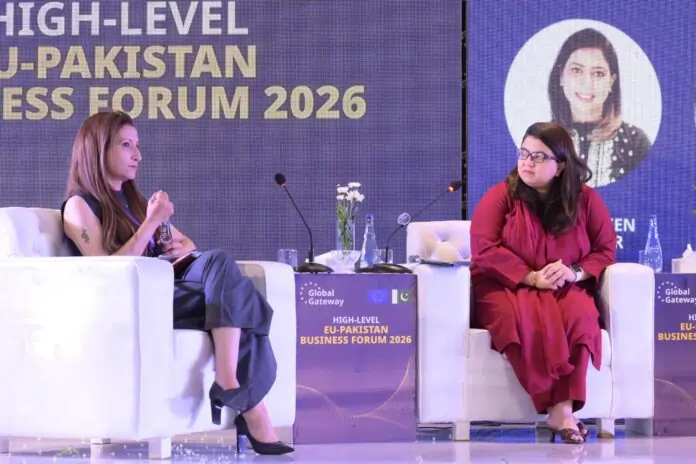
Speaking at the EU–Pakistan Business Forum 2026, she said, “Only 16 percent of our towers are fiberized at this point. Our target is that in the next three years, we will increase that to almost 60 percent.”
She said Pakistan is also working to significantly expand fiber connectivity at the household level, increasing fiberized home passes from around 2–3 million to at least 10 million within the next two years.
She said these targets form part of Pakistan’s broader national fiberization strategy aimed at strengthening connectivity, expanding broadband access, and enabling digital transformation across sectors.
The minister said the government, under the direction of the Prime Minister, has removed Right of Way (RoW) charges to facilitate fiber deployment across the country. She said the policy shift is designed to make fiberization more attractive for private sector investment and accelerate infrastructure rollout.
“This has made fiberization business-friendly and investment-ready, allowing the private sector to take a leading role,” she said.
She added that improving digital connectivity is a core priority under the government’s vision of “Digital Nation Pakistan.”
Highlighting progress in international connectivity, Shaza Fatima said Pakistan has successfully landed two to three submarine internet cables. She said two of these are expected to become operational within the current year, while another will be activated next year.
She said these developments will significantly improve Pakistan’s global internet bandwidth and connectivity resilience.
The minister also said Pakistan has signed agreements with Central Asian countries aimed at positioning the country as a regional data transit hub.
She said Pakistan has already operationalized data transit routes from China to Karachi through the national fiber backbone, while alternative connectivity routes are being developed via Central Asia and the Wakhan Corridor, strengthening regional digital integration.
Addressing Pakistan’s telecom capacity challenges, she said the country has historically operated on a limited 274 MHz spectrum since the early telecom and 3G/4G rollout phase between 2014 and 2016.
She said this limited spectrum capacity has struggled to meet rising demand, especially with a rapidly growing digital user base and increasing data consumption.
She added that over the past two years, Pakistan has witnessed around 25 percent growth in data usage, driven by a young population of over 150 million digital-first users.
To address this gap, she said the government recently conducted a major spectrum auction involving five frequency bands ranging from 700 MHz to 3500 MHz.
She said a total of 480 MHz spectrum was successfully auctioned, which she described as one of the largest spectrum allocations globally. With this addition, Pakistan’s total spectrum capacity has increased to over 750 MHz.
“This is not a marginal improvement but a structural correction required for future connectivity needs,” she said.
She added that this expansion will improve existing 4G services and enable the rollout of 5G technology in the country.
The minister said Pakistan’s connectivity structure remains heavily dependent on mobile broadband, with around 98 percent of users relying on wireless networks.
She said only about 2 percent of users currently have access to fiber-based networks, highlighting a significant infrastructure gap that the government is now prioritizing.
She said fiber expansion is essential to meet future demand, improve service quality, and support digital economy growth.
Shaza Fatima said Pakistan’s economic and social structure is increasingly transitioning toward digital systems, including education, healthcare, logistics, and national security.
She said digital connectivity has become a fundamental baseline requirement for all sectors of governance and economic activity.
She added that international development partners, including the Asian Development Bank and the World Bank, are supporting Pakistan’s digital infrastructure development programmes.
She said the government is working to develop a comprehensive regional connectivity loop linking Karachi to Central Asia, the Caspian region, Azerbaijan, and Europe, strengthening Pakistan’s role in global digital transit networks.
The minister said Pakistan is also developing a digital identity system integrating citizen data across multiple services, including birth records, education, healthcare, property ownership, and business registration.
She said the aim is to create a unified digital ecosystem where citizens can access essential services through integrated platforms.
She added that a nationwide digital regulatory system is also being introduced, allowing businesses to access all relevant regulations through a single online interface.
She said entrepreneurs will be able to instantly access legal and regulatory requirements through a digital query system, improving the ease of doing business.
She said Pakistan is building a transparent and efficient digital investment ecosystem to facilitate both domestic and foreign investors.
She highlighted that Pakistan is aligning its regulatory framework with the General Data Protection Regulation (GDPR), calling it one of the most advanced global data protection standards.
She said adopting such frameworks is part of Pakistan’s effort to ensure trust, transparency, and regulatory consistency in the digital economy.
She added that Pakistan offers a large and growing market, with a population of over 240 million, more than 60 percent of whom are young.
She said the country has around 200 million mobile subscribers and 150 million mobile internet users, making it a significant destination for digital investment and outsourcing services.
She said the Special Investment Facilitation Council (SIFC) is ensuring continuity in economic and investment policies through a unified approach.
She said this continuity is essential to avoid policy disruption and ensure long-term stability in digital and economic reforms.
She also highlighted Pakistan’s digital payment infrastructure, particularly the RAAST system, saying it is helping transition the country toward a cashless economy.
She said this shift will improve transparency, reduce transaction time, and strengthen financial inclusion.
The minister said the EU–Pakistan Business Forum reflects growing engagement between Pakistan and Europe in the digital sector.
She said Pakistan offers opportunities for European companies in infrastructure, outsourcing, and digital services, and invited greater investment and cooperation in the sector.